


Mass spectrometry confirms a peptide’s identity by measuring its molecular weight and comparing it to the number the sequence predicts. If the measured mass matches the expected mass within a small tolerance, and the fragment pattern lines up with the amino acid sequence, you have strong evidence the peptide is what the label says. Suppliers such as Kylo Peptides publish testing documentation, which gives you something concrete to examine. The review takes about fifteen minutes once you have the lab report in hand, and the only prerequisite is a certificate of analysis that includes the actual spectrum, not just a pass/fail stamp.
That matters well beyond the lab. Every season brings fresh conversations about why kids play hockey: teamwork, resilience, confidence, a love of the game that lasts. None of those goals call for supplements, and young athletes should never use peptides without a physician’s guidance. Still, coaches, parents, and educators are increasingly asked about them, and knowing how verification works helps you ask sharper questions and spot weak claims.
This guide walks you through the materials you need, the stop conditions that should end your review, and a step-by-step process for reading the evidence. Plain language, no chemistry degree required.
Why Verifying Peptide Quality Matters (and Why Young Athletes Should Care)

Peptides are short chains of amino acids, the same building blocks that make up proteins, just in smaller packages. Your body makes thousands of them naturally. Some products sold online claim to copy or boost those natural peptides, and that’s where trouble starts.
Here’s the catch: a label is a claim, not proof. A vial can say it holds a specific peptide at a specific strength, but only testing can show whether that’s true. Identity matters because the wrong molecule can behave very differently than expected. Purity matters because leftover chemicals or fragments of the wrong sequence can hide in an otherwise convincing product. Contaminated and mislabeled products are a documented risk, especially with items sold outside regulated channels.
For young athletes, this is a teachable moment. Good evidence-based coaching already asks players to question hype and look for results that hold up. A well-run elite training program builds strength, speed, and skill through patient work, sleep, nutrition, and recovery, not through a shortcut in a vial.
There’s a sportsmanship angle too. Many peptides are restricted by regulated sport organizations, so an athlete who takes an unverified product could face eligibility problems on top of health concerns. Asking “what’s the proof?” isn’t being difficult. It’s the same habit that makes a smart, disciplined competitor.
Long-term development always beats a quick fix, and learning to demand evidence is part of that growth.
What Mass Spectrometry Actually Measures: A Plain-Language Primer
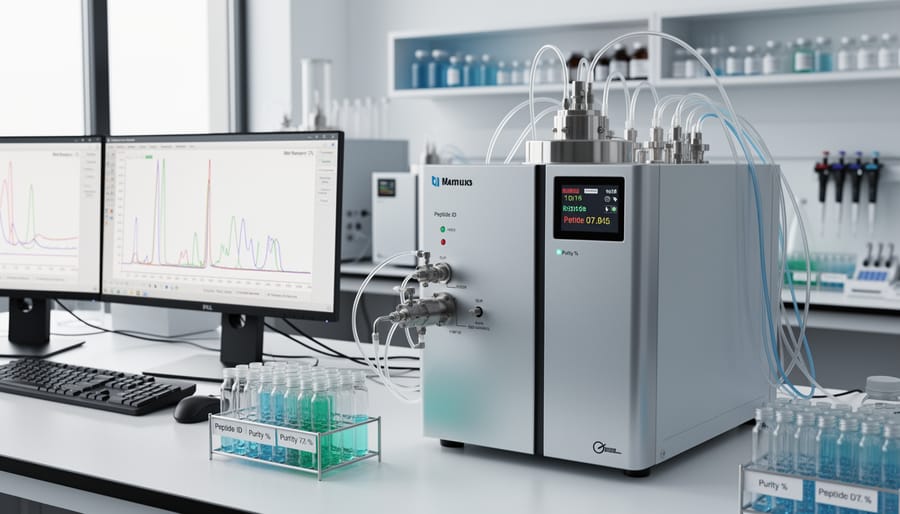
Think of a mass spectrometer as an extremely precise scale for molecules. Just as an equipment manager checks that a goalie’s pads meet weight and fit rules before a game, a lab uses this instrument to check that a peptide weighs exactly what it should. A peptide is far too small for any kitchen or bathroom scale, so the instrument works in a different way.
It takes three basic steps.
First comes ionization. The instrument gives each peptide molecule an electrical charge, turning it into an ion. Charged molecules can be steered by electric and magnetic fields, and uncharged ones can’t. Second, the ions travel through a chamber where they are separated based on their mass-to-charge ratio, usually written m/z. Lighter ions move through differently than heavier ones, and a higher charge changes how an ion behaves. Third, a detector counts the ions as they arrive and records how many of each m/z value showed up.
Two ionization methods come up most often:
– MALDI (matrix-assisted laser desorption/ionization) mixes the sample with a special crystal-forming material, then zaps it with a laser. It tends to give the molecule a single charge, which makes the results straightforward to read.
– ESI (electrospray ionization) sprays a fine mist of liquid sample into the instrument. It often gives a peptide several charges at once, so one molecule can appear at multiple m/z values. That sounds confusing, but software can work backward to the true molecular weight.
The detector’s output is called a mass spectrum, a graph with m/z along the bottom and signal strength up the side. Each peak is a group of ions of one particular size. A pure, correctly made peptide produces a recognizable pattern of peaks, a bit like a fingerprint. If the pattern doesn’t match what’s expected, something is off. The sample may contain a different molecule, a shortened version of the peptide, or leftover material from manufacturing.
That’s the heart of it: the instrument doesn’t take anyone’s word for what’s in the vial. It measures.
Tools and Materials Needed for Mass Spectrometry Peptide Verification
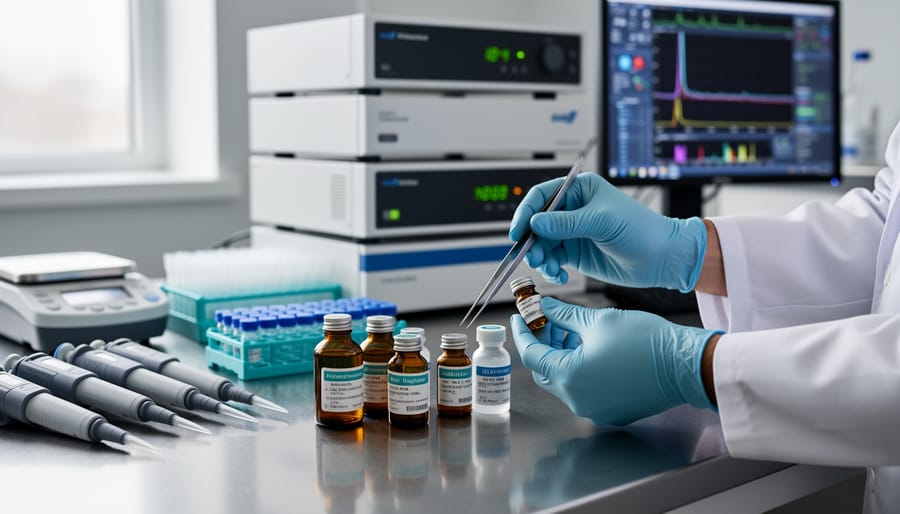
Verifying a peptide takes more than a single machine. It takes a handful of pieces that work together, and knowing what each one does helps you read a lab report with confidence. Here is the full checklist:
- The peptide sample, supplied in a small, properly labeled and documented amount.
- The reference amino acid sequence and its calculated theoretical mass.
- A mass spectrometer, either LC-MS or MALDI, often paired with HPLC for separation.
- Calibration standards so the instrument’s mass readings can be trusted.
- High-purity solvents to dissolve and carry the sample.
- Analysis software that turns raw signals into a readable spectrum.
- A qualified analyst or accredited laboratory to run and interpret everything.
The theoretical mass is the “answer key.” It comes from adding up the known weights of each amino acid in the sequence, so the lab knows exactly what number the measurement should land near. Calibration standards act like a scale that has been checked against a known weight before anyone steps on it.
Here is the part that matters most for coaches, parents, and educators: nearly all of this belongs in a professional lab. Handling solvents, running instruments, and interpreting spectra requires training and safety controls, so this is not something to try at home or in a classroom.
What a non-scientist can do is ask for and read the certificate of analysis. A trustworthy report names the lab, lists a batch number, states the expected and observed mass, and shows the purity result. Learning to ask for that document is a simple, powerful habit of science literacy.
Safety Warnings and Stop Conditions Before You Trust (or Test) a Peptide
Before you trust or test any peptide, a few safety rules come first. Handling samples and the chemicals used to prepare them belongs in a professional laboratory, with trained staff, proper ventilation, and protective equipment. This is not a kitchen-table or locker-room project.
Never self-administer research-grade or unverified peptides. “Research use only” means the product was never meant for human bodies. Minors should never use peptides at all without a physician’s oversight. The same care we bring to teens athlete safety in every other area applies here, and a doctor, athletic trainer, or school nurse is always the right first call.
A clean mass spectrum is also not a green light. It tells you a molecule matches its expected weight. It says nothing about dosing, side effects, or whether a substance is banned by a sport organization.
Treat any of these stop conditions as a clear “do not use”:
– The measured mass does not match the expected (theoretical) mass.
– There is no lab report, or the report is vague, edited, or missing a batch number.
– The testing lab cannot be identified or contacted.
– The source of the product cannot be verified.
– The seller makes health or performance promises the evidence cannot support.
If any of these show up, pause and ask a trusted adult or medical professional for help. Choosing patience and proof over shortcuts is a lesson worth modeling for every young athlete.
Step-by-Step: How a Lab Verifies Peptide Identity and Purity
Think of this as a lab’s checklist. Each step answers one question: what should this molecule weigh, is that what we see, and what else is mixed in with it? Here is the order a trained analyst follows.
- Calculate the theoretical mass. Using the amino acid sequence, the analyst adds up the known weight of each building block to get the expected molecular weight. This is the target number, the “right answer” before anything is measured.
- Prepare and dissolve the sample. A tiny amount of peptide is weighed and dissolved in a suitable solvent. Clean preparation matters because stray contaminants can show up as false signals later.
- Separate components with HPLC. High-performance liquid chromatography sorts the mixture so the main peptide and any impurities exit the system at different times, rather than arriving all at once.
- Ionize and run the sample. As each fraction leaves the HPLC, the mass spectrometer gives the molecules an electrical charge and measures how they move, which reveals their mass-to-charge ratio.
- Read the spectrum and find the main peak. The result is a graph of peaks. The tallest, most prominent one should correspond to the peptide being tested.
- Compare observed to expected mass. The measured value is checked against the theoretical one. A close match within a small, accepted tolerance supports the claim that the right molecule is present.
- Look for impurity peaks. Smaller peaks can signal truncated sequences (chains that stopped growing early), leftover salts, or reagents from manufacturing. Their size and number tell you how clean the sample is.
- Optionally confirm the sequence with MS/MS. Tandem mass spectrometry breaks the peptide into fragments and reads their masses, offering stronger evidence that the amino acids are in the right order.
- Document everything in a report. The lab records the sample details, methods, observed values and findings so someone else can review and trust the work.
A few points help put this in context. Matching mass is strong evidence of identity, but two different peptides can share the same weight, which is why the optional sequencing step in tandem MS exists for situations that demand more certainty. Likewise, HPLC and mass spectrometry answer different questions: one estimates how pure a sample is, and the other confirms what the main component actually is. Used together, they paint a far more reliable picture than either could alone.
This is also a good moment to teach young athletes a habit that carries well beyond the lab: good conclusions come from careful, ordered steps, not shortcuts. And while understanding the process builds science literacy, it is not a green light for anyone to handle or use peptides themselves. Questions about health, training, or supplements belong with a physician or qualified professional.
How to Read the Results: Verification and Next Steps

Start with the headline comparison: the measured mass against the theoretical mass calculated from the amino acid sequence. These should agree within the lab’s stated tolerance. If the report gives no tolerance or no theoretical value, you can’t judge the match at all.
In ESI, a peptide often shows up as several peaks at once, called charge states. Each peak carries a different number of charges, written as m/z values, and good software converts them back to a single molecular weight. Don’t panic when you see a cluster of peaks. That is normal. What matters is that the converted mass lands on the expected number.
Next, look at purity. Mass spectrometry confirms identity, while the purity percentage usually comes from HPLC. A trustworthy report shows both side by side, along with extra peaks that suggest truncated sequences, salts, or leftover reagents.
Watch for these red flags:
– No batch number tying the report to your specific product
– No lab name, contact details, or accreditation
– A spectrum that looks cropped, edited, or reused
– Round, vague claims like “99% pure” with no chromatogram or data
If the results match and the paperwork is complete, you’ve confirmed identity and purity. You still haven’t confirmed that the product is safe, legal, or appropriate for any young athlete. Only a physician can weigh that.
If anything doesn’t match, stop. Contact the supplier and ask for the raw data. Then bring in a physician, athletic trainer, or school health staff, and ask them how to dispose of the product through proper channels, such as a pharmacy take-back program.
Asking “where’s the proof?” is a skill worth teaching. It serves athletes long after their playing days end.
Common Questions About Peptide Testing and Mass Spectrometry
Does mass spectrometry alone prove a peptide is pure?
No. Mass spectrometry confirms that the main component has the expected molecular weight, but it isn’t designed to measure how much of a sample is the right peptide. Purity is usually reported from HPLC, so the strongest reports show both.
What’s the difference between MS and HPLC?
HPLC separates a sample into its parts and shows how much of each is present. Mass spectrometry weighs those parts to identify them. Think of HPLC as sorting the players onto lines and MS as checking each player’s jersey number.
Does a passing result mean a product is allowed in sport?
Not at all. A match only says the molecule is what the label claims. It says nothing about safety for humans or whether a substance is prohibited by a sport’s governing body.
Where can families learn more from reputable sources?
Start with a family physician, a certified athletic therapist, or a school nurse. National anti-doping agencies and sport governing bodies also publish plain-language guidance for athletes and parents.
Two practical questions come up often. First, can a school or team test supplements? Realistically, no. Analysis requires specialized instruments and trained chemists, so it’s handled by accredited laboratories, and most programs would be better off investing in education than testing. The most useful thing a coach can do is teach athletes to ask for a batch-specific lab report and to talk with a doctor before taking anything new.
Second, how accurate is the measurement? Modern instruments measure molecular weight very precisely, and labs compare the result to the expected value within a set tolerance. That accuracy is why a clear mismatch is such a strong warning sign. It still can’t tell you whether the product is safe or appropriate for a growing athlete.
For young players, the foundation is still simple: balanced meals, good sleep, and wholesome fuel like healthy snacks that support performance and recovery without any guesswork.
Curiosity is a training habit. The athlete who asks why a drill works, or how a coach knows a plan is sound, is building the same muscle that makes a good scientist: the willingness to ask for proof before putting trust in a claim.
That’s the heart of what mass spectrometry teaches us. By measuring a peptide’s molecular weight and comparing it to what the sequence says it should be, a lab can confirm identity. But that single measurement isn’t the whole story. It works best alongside purity testing and a report that’s honest, complete, and traceable to a real batch and a real lab. And even a clean result never means a product is safe, legal, or appropriate for a young athlete.
So bring this thinking into your gym, your classroom, and your family conversations. Encourage questions. Point kids toward physicians, athletic trainers, and school nurses when health decisions come up.
The best athletes learn to value patience over shortcuts, evidence over hype, and long-term health over quick results. Keep teaching that. It will serve them long after the final buzzer.